A megawatt figure may be a utility contract, the size of a substation, the power planned for computing, permitted backup generators, a proposed power plant or a solar deal somewhere else. These measure different things, for different parts of a site, at different stages. None of these figures, by itself, establishes how much electricity a site actually uses. A figure can be accurate and still be misread; this page is about what each kind establishes.
Going to a meeting? Ask of any figure: What does it measure? Which part of the site? What stage is it at? Is it a maximum, a design figure or an average? Who said it, and when? When would any generation run? The full questions →
Put a real figure on the picture
Choose a figure from this site’s records:
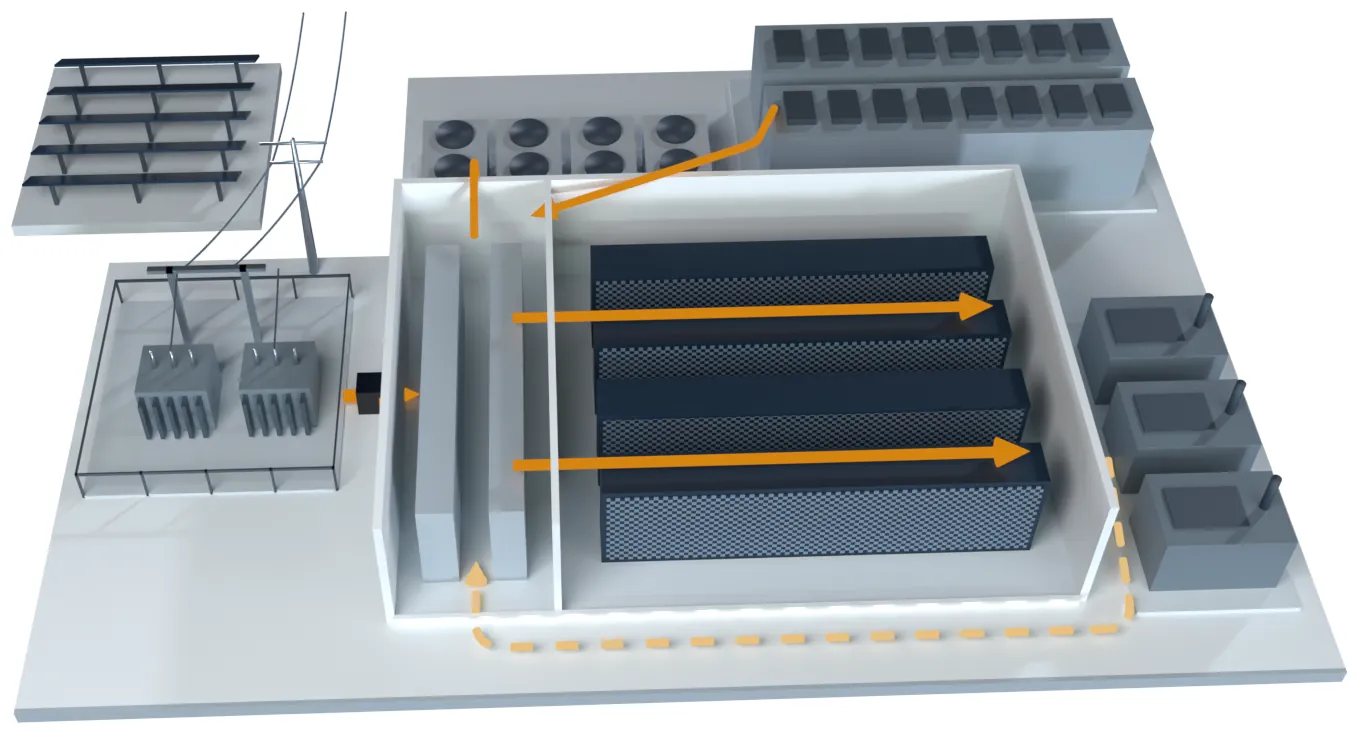
A contract elsewhere · B grid connection · C substation · D meter · E computing · F cooling and support · G backup generators · H generation at or near the site
Illustration, not a particular facility and not any company’s drawing, and not to scale. It shows where each kind of figure belongs; it does not depict the selected project. Equipment and combinations vary by site. Arrows show direction, not measured amounts.
Project Cannoli, Van Buren Township, Michigan
Reading tested: Treating DTE Electric's 1,000 MW Google contract as current measured load or critical IT capacity.
- On the picture
- Measures B, the grid connection.
- What it measures
- “the maximum load at the facility is 1,000 MW”, also called “contract capacity”.
- Stage
- “planned to begin materializing in December 2027, with max load achieved by December 2028”. It is “prefiled testimony, not an MPSC order, measured load, a stated critical IT capacity, or generation”.
- Why it matters anyway
- Minimum charges can be based on contract capacity even when actual use is lower. The utility’s testimony says “even if actual usage never reaches the 1,000 MW contract capacity, minimum monthly charges are calculated from that contract capacity”.
- Not known from this record
- MPSC final disposition of U-22058; whether load has materialized; measured load; critical IT capacity; executed public (non-confidential) contract text.
Read the full checked answer →
Original source: Qualifications and Public Direct Testimony of Neal T. Foley, DTE Electric Company, MPSC Case U-22058
Gilroy Data Center, California (AWS is the applicant)
Phase I of the Gilroy Data Center requires a 49 MW connection to PG&E.
- On the picture
- Measures B, the grid connection.
- What it measures
- A “city-stated Phase I utility-connection requirement”.
- Which part
- Phase I only. “the page does not state critical IT capacity, a campus-wide design capacity, or measured load”.
- Stage
- The city lists the project as “under construction”. “A building permit is permission to build, not opening or operation.”
- Not known from this record
- Critical IT capacity, measured load and the actual opening date.
Read the full checked answer →
Original source: Gilroy Data Center (by Amazon Web Services) — AS 20-23
Vantage, Fredericksburg, Virginia
Vantage says the Fredericksburg campus will have a private 270 MW on-site substation.
- On the picture
- Measures C, the substation and E, computing.
- What they measure
- Two figures from one page. “The 270 MW figure is the stated substation size. The page's 192 MW figure is combined critical IT load.” The 192 MW is a planned campus total.
- Do they add?
- No. A substation size and a computing load are different measurements of one campus, not two blocks of power. Subtracting them gives 78 MW, but that arithmetic alone does not show missing power, support load or efficiency.
- Stage
- “substation described as planned”. “The page does not say the substation is operating or that 270 MW is IT capacity.”
- Not known from this record
- Whether the substation is built or energized, and any utility filing that states its capacity.
Read the full checked answer →
Original source: Vantage Data Centers, Fredericksburg VA4 campus page
The 192 MW figure has its own checked answer: see that answer (Company claim) →
Polaris Forge 2, North Dakota
200 MW: critical IT load
- On the picture
- Measures E, computing.
- What it measures
- “contracted future critical IT load, not current or measured load, utility-service capacity or an entire future-campus total”.
- Which part
- “phased across the initial two buildings”, not the whole planned campus.
- Not known from this record
- Current or measured load, utility-service capacity and the future-campus total.
Read the full project record →
Original source: Applied Digital Form 10-Q for the quarter ended February 28, 2026
Intergate Quincy (Sabey), Washington
248.1 MW: permitted backup generation
- On the picture
- Measures G, backup generators.
- What it measures
- “Combined permitted emergency-generator capacity; not IT load or utility demand.”
- Which part
- The whole campus, stated as “up to” this figure.
- Why it matters anyway
- This permitted generator total shows what emergency equipment is approved, which is why it appears in an air-quality record. It does not show what the site draws day to day.
- Not known from this record
- Critical IT capacity, utility service capacity and measured load.
Read the full project record →
Original source: Washington Ecology Approval Order 26AQ-E016 and technical support document
Project Jupiter, Doña Ana County, New Mexico
Reading tested: Treating the requested 2,462 MW YGI Microgrid as issued generation capacity or data-center IT load.
- On the picture
- Measures H, generation at or near the site.
- What it measures
- Planned “solid-oxide fuel cells to generate 2,462 MW to power a nearby data center”. The record says “nearby”; the exact relationship to the site is not established.
- Stage
- “2,462 MW is requested generation in a pending air-permit application. It is not issued capacity, not utility demand, and not data-center IT load.”
- When checked
- The proceeding was stayed by the state Supreme Court before the scheduled September hearing. A newspaper later “reported on September 17, 2026 that the Court lifted the stay”. “This check found no hearing outcome, secretary's order, or issued permit.”
- Not known from this record
- Rescheduled hearing date and outcome; whether NSR 10883 is later issued, denied, or withdrawn; data-center IT load; utility demand.
Read the full checked answer →
Original source: Amended Notice of Public Hearing — Yucca Growth Infrastructure, LLC, YGI Microgrid, AQB 26-57(P), NSR 10883
Meta, Lebanon, Indiana
1 GW designed capacity
- On the picture
- Possible readings the record does not settle: B, a utility service; E, computing; or E and F together.
- What it measures
- “1 GW designed capacity”. This record does not say whether that means computing, computing plus support, or a utility service, so the figure sits off the equipment here.
- Stage
- A second record on this site says the reviewed sources “do not establish current metered load, a completed buildout or a comparable utility-service commitment”.
- Not known from this record
- Contracted, energized and measured load.
Read the full checked answer →
Original source: Company statement
Reading this as current measured grid demand is tested separately: see that answer (Contradicted) →
TotalEnergies and Google, Texas
TotalEnergies signed two long-term power purchase agreements for 1 GW of solar capacity, described as 28 TWh over 15 years, from Wichita and Mustang Creek in Texas.
- On the picture
- Measures A, a contract elsewhere.
- What it measures
- Solar nameplate capacity under contract: “1 GW of solar capacity, equivalent to 28 TWh of renewable electricity over 15 years”.
- Which part
- No particular data-center building or IT load is identified. “The page does not name a data-center building, an IT capacity, or hourly matching.”
- Capacity is not output
- Arithmetic from those two numbers: 1 GW running flat out for 15 years would be about 131 TWh, and 28 TWh is about a fifth of that. Solar panels do not generate at night, so continuous output at nameplate is only a hypothetical comparison. This does not establish actual generation.
- Stage
- “A company announcement of an agreement is not a record that the electricity has been generated.”
- Not known from this record
- Whether the plants are built or the energy is generated. Which Google facility takes it. Hourly or physical matching. The contract text itself.
Read the full checked answer →
Original source: TotalEnergies news release, 9 February 2026
“Contradicted” on a tested reading means that reading of the figure does not hold; it is not a finding against the figure or the company. “Company claim” records what a company said, without a finding either way. Quotation marks show words from this site’s record of each figure, which may itself quote the source. This page relies on those records and does not review each company’s full documents.
One site can have several numbers at once
- Different things, so don’t add them. The record for Northtown in San Jose holds up to 97.3 MW of proposed backup generation and says “it must not be summed with the 110 MVA substation rating”. Vantage’s figures above work the same way.
- Different stages. Polaris Forge 1 in North Dakota has an operator-reported 175 MW of “total live capacity at the campus”, and “The 400 MW contracted at full build-out is a separate planned figure”.
- Sometimes they do add. At DataBank’s Culpeper campus in Virginia, the company’s pages give 72 MW and 120 MW of planned critical IT load for two buildings and 192 MW for the campus. “The building figures add to the campus figure.” They are the same kind of figure, from the same source.
Why these project figures should not be added into a national total
Adding them would mix contracts, equipment, computing loads and plans, and these records are not a census. This site’s methodology says capacities of different kinds are never added together. This is what the capacity field of the 86 national project records holds today:
| What the record’s figure is | Project records |
|---|---|
| Utility request or connection | 3 |
| Critical IT load | 2 |
| Planned generation, including proposed backup | 6 |
| Permitted backup generation | 2 |
| Company design figure | 1 |
| A figure whose kind is not established | 1 |
| No value in the project capacity field | 71 |
An empty field is not a claim that a project is small, and some records mention other figures elsewhere. This table summarizes the project capacity field; it does not establish measured electricity use.
Power is not energy
A megawatt (MW) is a rate of power at a moment. A megawatt-hour (MWh) is energy used over time. The U.S. Energy Information Administration puts it this way: a generator with 1 MW of capacity that runs at that level for one hour produces 1 MWh, and “Many generators do not operate at full capacity all the time.” A request, capacity or rating is not an average draw. You can try the arithmetic in the guide’s calculator.
What each part of the picture is
- A contract elsewhere. A company may contract for power from a generator that is not at the data center. The physical grid may serve many customers even when a contract is tied to a particular generator.
- Grid connection. A utility request, contract capacity or connection requirement. These are limits and plans, not use.
- Substation. Equipment that takes power from the grid for the site. Its size is not the site’s use.
- Meter. Where grid power coming in would be measured. With generation on site, that may not be the site’s whole use.
- Computing. Critical IT load: the power planned for, or available to, the computing equipment. Announcements may give a campus total instead.
- Cooling and support. Some electricity also runs cooling, electrical equipment and other support systems, so a site’s total use is more than its computing load. Power usage effectiveness (PUE) compares total facility energy with IT-equipment energy.
- Backup generators. Ratings appear in air-quality permits. Records on this site describe them as emergency equipment, not normal supply.
- Generation at or near the site. A planned power plant. Equipment varies: fuel cells in the Project Jupiter record, natural gas in others. Some plans also serve the wider grid. Its power would reach computing through the electrical rooms.
Six questions to ask about any megawatt figure
- What does it measure: a request, a contract, equipment size, computing load, generation or actual use?
- Which part: one building, one phase, the campus, full build-out, or a separate generation project?
- What stage is it: requested, approved, permitted, built, running or measured?
- Is it a maximum (“up to”), a design figure, or an average?
- Who said it, in what document, and when?
- When would any generation run: regularly, intermittently, for testing or in emergencies? Would it also export to the grid?
Plain words
- Generating capacity: the maximum output a generator can produce under specific conditions. Generation: what it actually produces over time.
- Nameplate: the capacity a manufacturer states for a generator.
- MVA: a rating unit for electrical equipment such as substations; related to, but not the same as, MW.
- Prefiled testimony: written testimony given to a regulator before a hearing. MPSC: the Michigan Public Service Commission.
- TWh: a terawatt-hour, one million MWh.
- Full build-out: everything planned for a site, once finished.
Go further on this site
How data centers work · Types of data center · Power answers · Project records
Sources for the definitions: U.S. Energy Information Administration, generation capacity and generation and measuring electricity, and this site’s guide. Each figure’s own sources are on its record. This is a general explanation, not a description of any facility on this site. Figures and counts are from this site’s records as built.