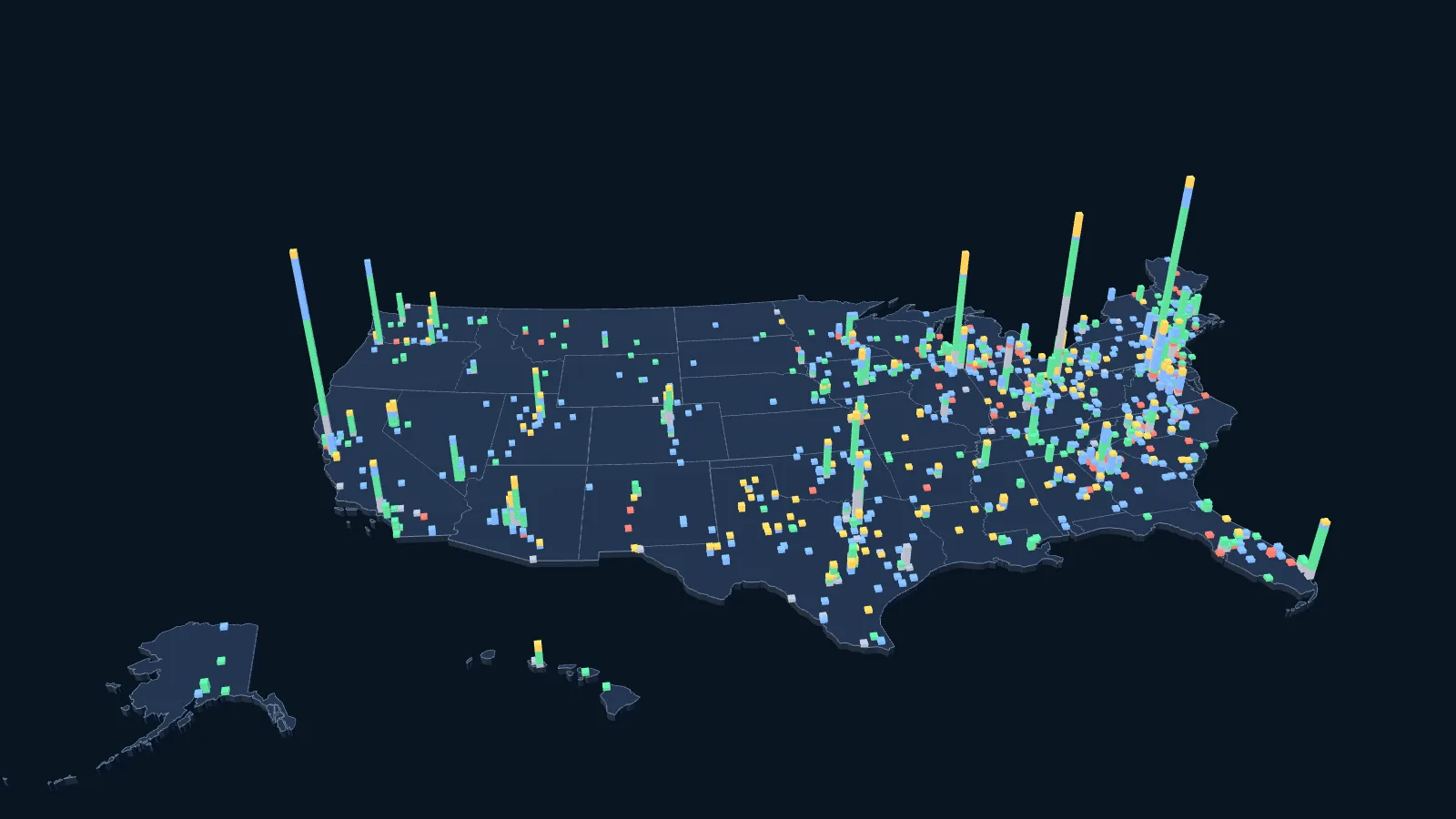
3,115 data center source listings, 2,160 mapped in 3D
One block is one source listing, not one verified site. Turn it, zoom in and search by name, operator or town.
Simplified model, not a particular facility. Sizes and distances are compressed. Motion shows direction, not a measurement.
These are the site’s 86 national records, including some buildings and operating facilities. State collections such as Indiana and Ohio are not in this view, so this is not the homepage’s project count.
Latest dated events in these records
Newest first, from these records only, so not all news about any project. A date with no day sorts at the end of its month or year.
Simplified model, not a particular facility. Sizes and distances are compressed. Motion shows direction, not a measurement.
For the latest checked answers linked to each part, open the full guide.
Servers do the computing. Electrical systems deliver and condition power. Cooling systems move heat away. Networks move data. A campus can contain several buildings built in phases, so one announcement is not automatically one operating facility.
1Grid connection and substation
Utility lines bring electricity to the site, and a substation steps the voltage down.
- Number you’ll see
- A utility-service request, contracted capacity or service limit, in megawatts (MW): a rate of power at a moment.
- Usually recorded in
- Utility and state utility-commission filings, which can establish requests, contracts or cost-allocation rules.
- Does not prove
- How much electricity the site uses. A request, a contract and measured grid load are different numbers, and energy used over time is counted in megawatt-hours (MWh). The physical grid may serve many customers even when a company signs a contract tied to a particular generator.
On this site: power answers · ratepayer brief
2Transformers and switchgear
Transformers, switchgear and power-conditioning equipment step the voltage down, route power and keep it steady for the computing equipment. Battery systems, often called UPS, carry the load through the short gap before backup generators start.
- Number you’ll see
- Equipment ratings, often in kVA or MVA. A rating is what that equipment is built to handle.
- Usually recorded in
- Building and electrical permits and plans, which authorize defined work.
- Does not prove
- That the work finished, or how much power actually flows. A rating is not the load.
On this site: power answers
3Backup generators
On-site generators, often diesel, run during grid outages and for routine testing.
- Number you’ll see
- How many generators and their rating, in kilowatts (kW) or megawatts (MW).
- Usually recorded in
- State or local air permits, which authorize defined emissions and can limit running hours.
- Does not prove
- What the data center draws from the grid. A generation rating says what equipment could produce, not what the site uses.
On this site: air permits have not yet been checked.
4Data halls and servers
Rooms of servers, storage and network equipment do the computing. They turn most of the electricity they use into heat.
- Number you’ll see
- Critical IT load: the power planned for, or available to, the computing equipment, in MW. Announcements may give a campus total instead.
- Usually recorded in
- Company announcements and planning or zoning applications.
- Does not prove
- Measured use. An announcement proves the company made the statement. A campus can contain several buildings built in phases, so one figure is not automatically one operating facility.
Power usage effectiveness (PUE) compares total facility energy with IT-equipment energy. It does not reveal a site’s total electricity use by itself.
On this site: every total and what it counts
5Cooling inside the building
Fans, coils and pumps move heat away from the equipment: by air, by liquid piped to the chips (direct-to-chip) or by immersing equipment in fluid.
- Number you’ll see
- Usually none. The design is described in words such as “air cooled”, “liquid cooled” or “closed loop”.
- Usually recorded in
- Company statements, and sometimes planning documents.
- Does not prove
- Water use. “Closed loop” usually describes recirculation inside part of the system. It does not, by itself, prove zero withdrawal or zero consumption. The heat still has to leave the site (part 6).
On this site: cooling and water record set
6Heat out: cooling towerdry cooler
A cooling tower carries heat away by evaporating water. The evaporated water is consumed. Make-up water replaces it, and some water is drained off (blowdown) to limit mineral build-up; that drained water becomes discharge.
A dry cooler blows air across coils that carry the warm loop. Running dry, it evaporates no water. Electricity demand depends on the weather, operating temperatures and the rest of the cooling system. Some designs spray water on the hottest days, and that water evaporates.
Sites can also use chillers, or a combination of these.
- Number you’ll see
- Usually a design described in words. Water figures appear with the water connection (part 7).
- Usually recorded in
- Company statements and site plans.
- Does not prove
- How much water or electricity the site uses. Climate, utilization and cooling design all change the result.
On this site: cooling and water record set · water answers
7Water in and out
A water connection supplies the site, and a sewer or discharge connection takes water away. With a cooling tower, the cooling system takes in make-up water and sends blowdown to discharge.With dry coolers, cooling may need little make-up water, but the site can still withdraw water for other uses.
- Number you’ll see
- Water withdrawal, consumption or discharge, often as a permitted or contracted maximum, in gallons per day or millions of gallons per year.
- Usually recorded in
- Water-utility agreements, withdrawal permits, and wastewater or discharge permits.
- Does not prove
- How much water is used. A permitted or contracted amount is a limit or a commitment, not a measurement. Withdrawal, consumption, discharge, potable water and reclaimed water are separate measures, and water used to generate the site’s electricity is a separate, off-site figure.
On this site: cooling and water record set · water answers