“Closed loop” usually describes recirculation inside part of a cooling system. The phrase alone does not say which part, how the heat leaves the site, how much water fills and tops up the loop, or how much water the whole site uses. A closed-loop design can use little water, depending on how heat is released and which water uses are counted; this page is about what a given sentence establishes.
Going to a meeting? Ask which loop, how the heat leaves, how much fill and top-up, whether any “zero” means all year, whole site or only cooling, and design or measured. The six questions →
Put a real claim on the picture
Choose a claim from this site’s checked answers:
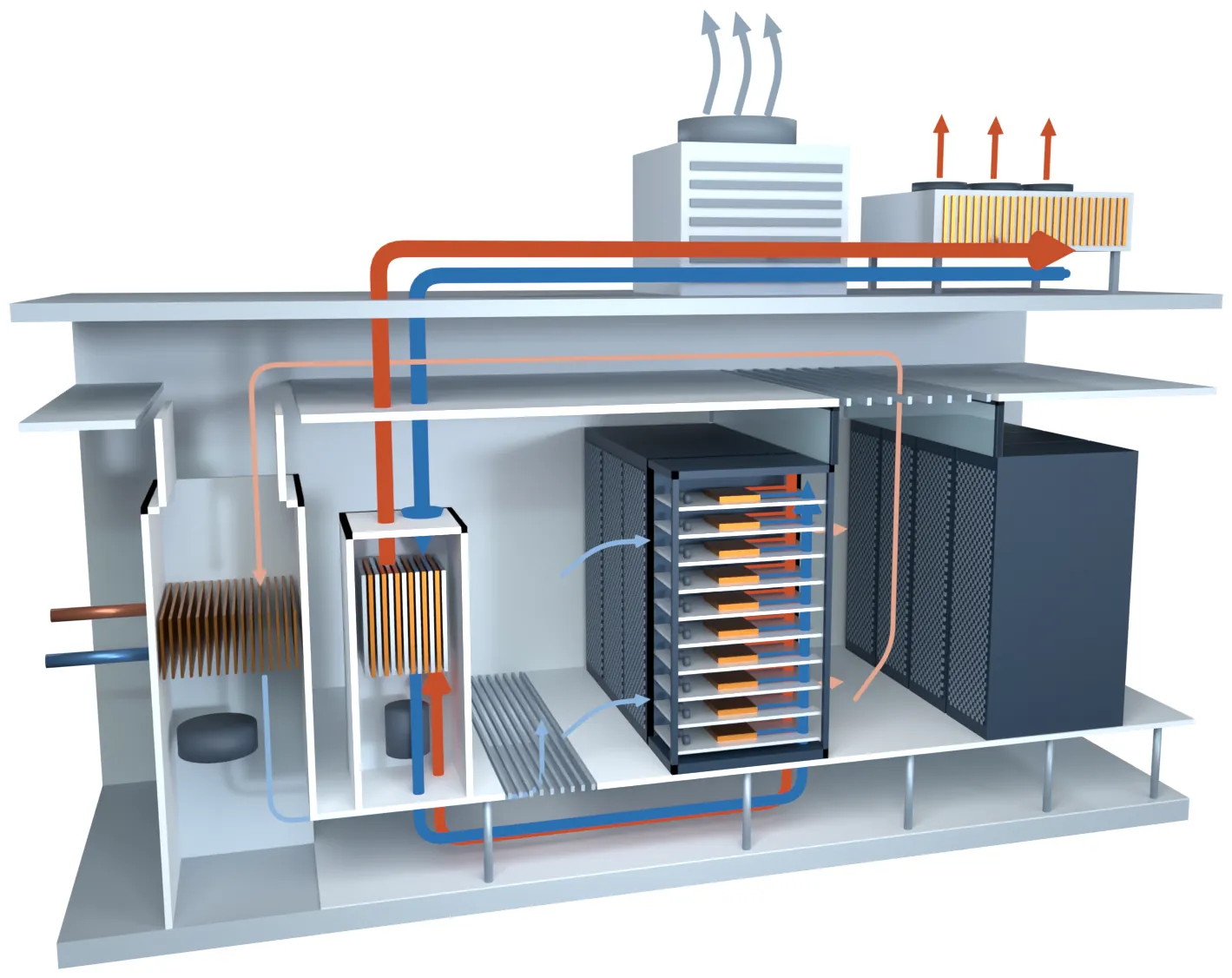
Illustration, not a particular facility and not any company’s drawing; the near end of the building is cut away and pipes at the left edge continue out of view. Both heat-out options are drawn so you can compare them: a real site may use either, both, or chillers as well. Arrows show direction, not measured amounts.
Meta, Lebanon, Indiana
Closed-loop liquid cooling; zero cooling water for most of the year
- On the picture
- Possible examples, not identified: A, the loop at the chips and B, the facility water loop.
- Which loop
- “Closed-loop liquid cooling”, in a design that will “recirculate cooling water”. The record does not say which loop.
- How heat leaves
- Not in this record. “the heat-rejection architecture used in operation” is listed as unknown.
- Water figure
- “zero cooling water for most of the year”. That is “narrower than zero annual or total campus water use”.
- Basis
- “a future design claim until operating measurements exist”.
- Not known from this record
- Actual annual withdrawal and consumption, potable and nonpotable shares, the heat-rejection architecture used in operation, and operating measurements.
Read the full checked answer →
A common reading, that this means the campus will use no water, is tested separately: see that answer (Unknown) →
Microsoft, Mount Pleasant, Wisconsin
Microsoft says its Mount Pleasant pilot will use closed-loop chip-level cooling without evaporating water for cooling.
- On the picture
- Names the function of A, the loop at the chips. Possible examples, not identified: C2, a dry cooler. Rules out evaporative cooling as drawn at C1.
- Which loop
- “closed-loop chip-level cooling”: the function of the loop at the chips. The record does not confirm the equipment as drawn here.
- How heat leaves
- “without evaporating water for cooling”. The record does not name the equipment that releases the heat.
- Water figure
- No water volume in this record. “initial-fill volume” is listed as unknown.
- Basis
- “This is a design claim, not an operating measurement.”
- Not known from this record
- Operating configuration, initial-fill volume, other site water uses, and measured withdrawal, consumption, and discharge.
EdgeCore, Reno, Nevada
Upon completion, EdgeCore says its Reno campus will support 216 MW of critical IT load across about one million square feet on 56 acres.
- On the picture
- Possible examples, not identified: B, the facility water loop, C2, a dry cooler and D, room air.
- Which loop
- “an air-cooled, closed-loop design”. The record does not say which loop is closed or which part is air-cooled, and does not establish liquid cooling at the chips.
- How heat leaves
- Not clear from the record. “air-cooled” may describe this step, the rooms, or both.
- Water figure
- “uses very little water”, with a water-use effectiveness rating “below 0.01 liters per kilowatt-hour”. That is a ratio, not a total.
- Basis
- A company page describing a campus “upon completion”.
- Not known from this record
- Measured water use.
Vantage, Fredericksburg, Virginia
Vantage says its Fredericksburg campus is planned for 192 MW of critical IT load, 929,000 square feet on 82 acres, N+1 electrical and mechanical design, and near-zero water-use effectiveness, with the first building in late 2027.
- On the picture
- Possible examples, not identified: B, the facility water loop.
- Which loop
- “a closed-loop chiller system”. The record does not identify which circuit is closed. Chillers are not drawn in this picture.
- How heat leaves
- Chillers are named. How the chillers release their heat is not in this record.
- Water figure
- “water-use effectiveness near zero”, with no number in this record. That is a ratio, not a total.
- Basis
- “These are planned company figures, not an operating campus.”
- Not known from this record
- Whether the stated water-use figure has been measured.
AWS, Gilroy, California
The City of Gilroy says AWS's Phase 1 data center is expected to use approximately 23 acre-feet of potable water per year, falling to an estimated 2 acre-feet per year after a required switch to recycled water.
- On the picture
- Possible examples, not identified: C1, a cooling tower.
- Which loop
- Not a closed-loop claim. This is the City’s evaporative-cooling example: the project “will use evaporative cooling for the current project”.
- How heat leaves
- Evaporative cooling is stated. The tower drawn here is one possible example, not identified equipment. The record also says “cooling water is discharged to the sewer”.
- Water figure
- “approximately 23 acre-feet of potable water per year in Phase 1”, later “2 acre-feet per year” after a required switch to recycled water. “potable water only”.
- Basis
- “the City's estimates and a condition of approval, for a building the city lists as expected online in 2028”.
- Not known from this record
- Whether the 23 acre-feet is a Phase 1 figure, as the Q&A says, or a full-buildout figure, as the fact sheet says; measured potable or recycled water use after opening; the recycled-water volume; the recycled-water agreements' terms and whether they were completed; the Water Supply Assessment (the page lists it as Appendix O of the environmental review, not read); and the conditions-of-approval text.
“Not in this record” means this site’s checked answer does not record it, not that the company or city has never addressed it. This page relies on those checked answers and does not review each company’s full design documents. Quotation marks show words from the answer. Even where words name a function, they do not confirm the equipment as drawn.
What each part does
- The loop at the chips. Liquid runs through cold plates on the chips, taking up heat where it is made, then returns to a cooling distribution unit, the open cabinet in the picture.
- The facility water loop. The distribution unit passes that heat to the building’s own cooling loop, which carries it toward the outdoors. A sentence saying “closed loop” may mean this loop, the one at the chips, both or another circuit.
- Heat out. A cooling tower (C1) releases heat by evaporating water, even when the loops before it are closed; the water it evaporates can be separate from those loops. A dry cooler (C2) blows air across coils: running dry, it evaporates no water, and how well it works depends on the outdoor temperature.
- Room air. Some liquid-cooled systems are hybrids: the liquid takes most but not all of the heat, and ordinary air cooling removes the rest.
Not in this picture
- Water to fill and top up the loops.
- Other site water, such as irrigation in the Gilroy record.
- Water used to make the electricity. The U.S. Department of Energy notes a version of water-use effectiveness that counts water used off-site to produce the energy.
Water-use effectiveness (WUE) is annual site water use divided by the energy used by all IT equipment, in liters per kilowatt-hour. It is a ratio, so a low figure does not give the total on its own.
Six questions to ask about any closed-loop claim
- Which loop or circuit is closed: the one at the chips, the facility water loop, or another?
- How is the heat finally released or reused, including heat from any chillers? Does that change in hot weather?
- What fills each loop, how much is needed at the start, and how much top-up is expected?
- If “zero” or “near zero” is claimed, does it mean all year or part of the year?
- Does the figure cover the whole site or only cooling, and all water or only drinking water?
- Is it a design estimate, an operating measurement or something else, and will actual use be reported?
Plain words
- Heat rejection: releasing heat outdoors.
- Potable: drinking-quality water.
- Withdrawal: water removed from a ground or surface source for use. Consumption: the part of it that evaporates or is otherwise removed from the immediate water environment.
- Make-up or replenishment: water added to replace what a system has lost.
Go further on this site
Cooling and water evidence · Types of data center · All water answers · Follow the heat in the guide’s explorer
Sources for how the system works: U.S. Department of Energy, Best Practices Guide for Energy-Efficient Data Center Design (revised July 2024), sections 5.2, 5.4, 5.6 and 8.3, and this site’s guide. Water terms: U.S. Geological Survey, water-use terminology. Each claim’s own sources are on its checked answer. This is a general explanation, not a description of any facility on this site.