This example shows one established arrangement, in which air circulates in a loop: cool air is supplied under a raised floor and warm air returns through the ceiling. Other halls supply air overhead or use cooling units within the rows, and some high-density equipment is cooled by liquid piped to the chips instead.
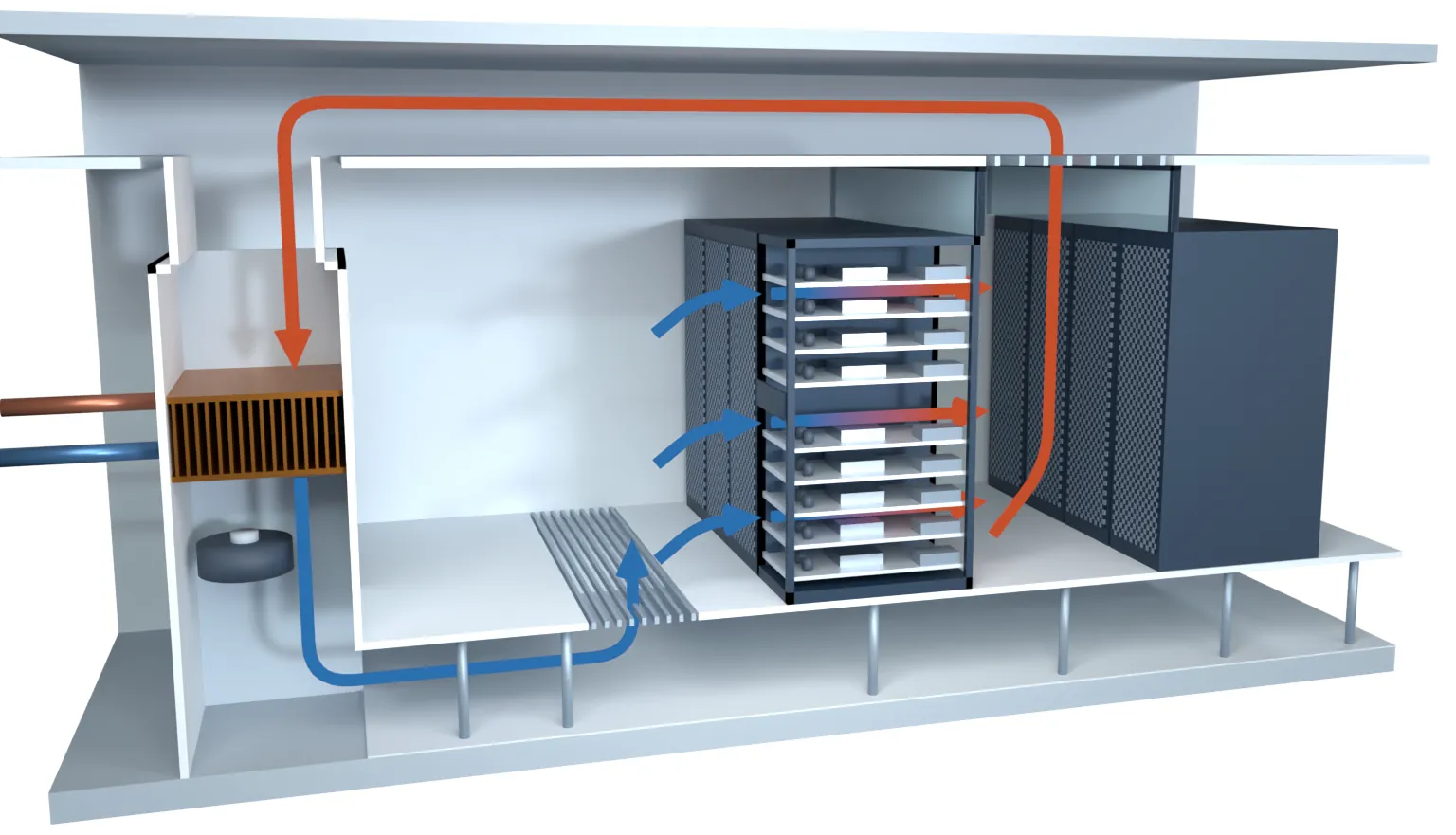
Illustration, not a particular facility; the near end of the room is cut away. Arrows show direction, not measured amounts or temperatures. Numbers match the steps below.
- Cool air reaches the cold aisle. A cooling unit pushes cool air under a raised floor, and it rises through perforated tiles into the aisle in front of the racks.
- Servers draw it in at the front. The fronts of the servers face the cold aisle, and fans in each server pull the air in.
- The air picks up the equipment’s heat. It carries heat away from the electronics. Blanking panels cover empty slots so air goes through the equipment, not around it.
- Warm air leaves at the back. Two rows stand back to back, so their warm exhaust collects in the hot aisle between them.
- A barrier helps keep the two streams apart. Panels or curtains above the racks and across the aisle ends (containment) limit warm air flowing back into the cold aisle.
- The cooling unit takes the heat out. Warm air returns through the ceiling, crosses coils carrying chilled water or refrigerant, and goes back under the floor. The water or refrigerant carries the heat onward, and the cooling system releases it outside (see “Cooling inside” and “Heat out” in the guide’s explorer).
Sources: ENERGY STAR guidance on hot aisle/cold aisle layout, containment and airflow management, and the U.S. Department of Energy’s Best Practices Guide for Energy-Efficient Data Center Design (revised July 2024). This is a general explanation, not a description of any facility on this site.
Go further on this site
How data centers work · Types of data center · Closed loop, decoded